Posts

The absurdity of the use of kph

Image
  First and foremost I apologise (yet again) for such a long gap in between blog posts. The return of freedom over the past year has kept me away from screens. They say it takes 66 days to develop a new habit. Running is a habit I developed over lockdown, but the return to the office (and I intend to never work from home again) and frequenting the pub has reduced frequency of this.  It is, however, not completely bleak for my physical well-being. Cramming a number of social events in after work has led to me doing a lot more walking around central London. I don’t have an Apple Watch, (other brands of smart watch exist), but my iPhone records my steps and a lot of really interesting data on my walking and running. As would be no surprise, I’ve configured everything in metric units. Thankfully, gone are the days where Apple would dictate to you , based on your location, the units of measurement you use. You have a chose whether to specify distances in miles or kilometres....

The absurdity of the use of kph

Image
  First and foremost I apologise (yet again) for such a long gap in between blog posts. The return of freedom over the past year has kept me away from screens. They say it takes 66 days to develop a new habit. Running is a habit I developed over lockdown, but the return to the office (and I intend to never work from home again) and frequenting the pub has reduced frequency of this.  It is, however, not completely bleak for my physical well-being. Cramming a number of social events in after work has led to me doing a lot more walking around central London. I don’t have an Apple Watch, (other brands of smart watch exist), but my iPhone records my steps and a lot of really interesting data on my walking and running. As would be no surprise, I’ve configured everything in metric units. Thankfully, gone are the days where Apple would dictate to you , based on your location, the units of measurement you use. You have a chose whether to specify distances in miles or kilometres....
Why cooking in metric is actually better

Image
One of the best things about the slow return to normality l is that I can once again have food cooked for me by a professional, and eat it in a restaurant.  I will confess that I do not enjoy cooking. However, I prefer this form of suffering to the misery of a substandard and lukewarm meal delivered to my front door an hour late by someone who probably fell off their bike or moped en route.  When I do cook, I tend not to follow recipes. I put things that I think go together and it usually turns out somewhere between passable and good.  Back when the UK was switching to metric units in the 60s and 70s, one of the common arguments against transition was that cooking in metric would be "strange, and make things taste different". Unsurprisingly, this argument does not hold, because cooking is about proportions. It therefore follows that it does not matter whether recipes use metric or imperial - as long as the proportions are the same.  Although this blog favours the use...

Could we try metric time?

Image
The beauty and fundamental benefit of the metric system is its ease of use, which is largely due to it being decimal. Within the system, it is simple to compare the measurements of objects. For example, it takes very little effort to convert or compare a centimetre to a kilometre – much less than comparing an inch to a furlong. For the most part, metric measures are based on an SI base unit, with sub units which are either a multiple or a fraction of ten of that SI unit. A simple example of this is the metre. It is the SI unit for length. A millimetre is 1/1000 of a metre and a kilometre being 1000 metres. However there are some exceptions. With mass, the kilogram is the SI unit, rather than the gram, but still, all measurements of mass are still based on ten around the gram. I am sure none of this is new, but I will get to the point eventually. The SI unit for time is the second. It is common for SI prefixes to be used for times shorter than a second (millisecond, nanosecond, ...

Is it possible to put a value on friendship?

Image
Lockdown has gifted us the luxury of time. Time to bake sourdough bread. Time to learn a language. Time to shed a few kg. Time to learn an instrument. Time time to read. More realistically, time to watch Netflix. In fact, this luxury of time reminds me of Ecclesiastes Ch.3. Anyone who has been to a church wedding or funeral would have heard it. To every thing there is a season, and a time to every purpose under the heaven: a time to be born, and a time to die; a time to plant, and a time to pluck up that which is planted; a time to kill, and a time to heal; a time to break down, and a time to build up; a time to weep, and a time to laugh;... I will spare you the rest.   As someone who is often too busy "doing things" rather than thinking about them, the inability to partake in my usual social activities has left me with ample time to think. Time to think about self-improvement. Time to think about the things that really matter. Time to think about the people who really matte...

The pint is inefficient, but I still want one

Image
I have not had a single alcoholic drink since New Year's Eve. Given the lockdown, I have little incentive to drink, and so have inadvertently done Dry January. I am halfway through February sober and with Lent fast approaching, may well not be seeing booze until Easter. (The key word here is may. This restrained life is going out the window as soon as we are allowed to socialise meaningfully again.) Unlike the non-drinkers, I will not get on a high horse and preach about the virtues of sobriety. Find your nearest convert to the Church of Tee-Totalism and they will no doubt tell you that quitting booze makes you more energetic, sleep better and think more sharply. Whether there's truth to that is a matter for science. However, I have noticed myself thinking more sharply about one thing in particular - getting my hands on a freshly poured pint of anything amber (except cider... or petrol). In my first post of the current era of this blog, "showing a bit of kindness to the im...

How do Godzilla and King Kong measure up for their 2021 battle?

Image
This is one of the "few other things" I mention in the strapline of the blog.  The last clash of the titans was in 1962. I was not alive then, but at some point in the late 90s/early noughties when I was around ten years old and absolutely crazy about Godzilla and the MonsterVerse, I saw in the TV guide that King Kong vs Godzilla was showing. I defied my parents and stayed up until 2 am to watch the film. I was excited. I had seen Godzilla emerge triumphant from battles with numerous other beasts. At this point, however I had not seen any King Kong films, but my brother had constantly told me that King Kong would be Godzilla's ultimate rival. I was eager to see this battle. By the end of the film, the excitement was replaced with anger and disappointment.  My idol was defeated by the oversized ape. I've detested King Kong ever since.  Fast forward two decades and the two titans are set to meet again, this time as CGI monsters and not men in rubber get-ups. If the pand...

Running... in kilometres

Image
I detest running. It is the most soul-crushingly monotonous recreational activity that mankind has inflicted upon itself. However with lockdowns, advancing age, limited exercise options and a fervent desire to not get a belly, it has become a necessary evil.  I now look forward to going for a run. This is temporary. But even in on a cold, grey day, it's an opportunity to absorb some daylight, catch up on a podcast and maybe even smile at another human being.   Despite going running almost every other day now, I don't cover huge distances. I average 5 to 10 km. People often seem quite impressed by that. I don't know why.  What does impress me is that whenever I'm asked how far I've run and I give an answer in kilometres, nobody asks me, "What's that in miles?"  People seem to simply understand.  The same universal understanding is not true when I use kilometres for anything else. For example, when giving someone directions. A significant proportion of p...

The problem with dual labelling liquids

Image
I was recently looking at double-walled coffee cups - thrilling, I know!  The specific gift request was for "double-walled coffee cups - large". By large, I took it to be at least 500 ml.  Double walled coffee cups are hard to find, but I did find some in the end from Argos. They had a stated volume of 350ml or 12 fluid ounces. Few people in this day and age in Britain know what an imperial fluid ounce is, and rightfully so. With the exception of draught beer and cider, and milk in returnable containers, liquids are sold in metric units and have been more and more since the late 1970s.  It therefore follows that drinking vessels (with some exceptions) should, when sold, mention only metric volumes. So for these coffee cups, there should not need to be any mention of it being 12 fluid ounces.  Whilst dual labelling is a bit cumbersome, it is not the end of the world. After all, priority was given to the metric units and it is probably a helpful step for the older gene...

The complex relationship between aviation and measurement

Image
“It’s a bird. It’s a plane. It’s... more confusion”  The aviation industry is one which holds a special place in my heart, but I won’t bore you with this soppy nonsense. The measurement muddle is truly alive in this industry, so much so, that it makes measurements in Britain seem coherent. Yet still, one of the few global industries manages to work in the midst of a monstrous measurement muddle. Whilst the language of aviation is standardised to English, there is no such standardisation for units of measurement. Metres, geographical miles, nautical miles, inches of mercury, millibars, knots, metres per second are some of the measurements you are likely to come across if you’re ever in the cockpit.  Let’s start with distances. In the UK, as in much of the world, most distances on the ground e.g. runway lengths, are given in metres. Once you airborne, despite flying being a fairly modern feat of engineering, you go back to the dark ages of measurement. Distances now become nauti...

George Orwell and metric units

Image
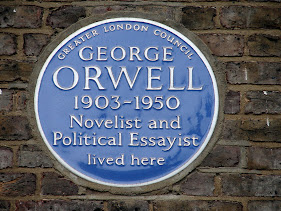
When I first read Animal Farm, I was too young to understand what it was about. I was completely oblivious to the fact that the book (novella, if you must) was an anti-Stalinist satire. I took it at face value, and thought very little about the actual message — though it did leave me with a permanent craving for bacon. The only thing that really landed for me while still in primary school, was the single law which the seven commandments eventually became. "All Animals Are Equal / But Some Are More Equal Than Others." In addition to being totally unaware of the political context of one of Orwell's finest works, I was also completely unmindful of the units of measurement used. In fact, when I re-read it much later on, it was no surprise to me that all units of measurements were imperial. After all, it was published in 1945. Although metric units were first permitted for use in the UK in 1897, they didn't come into common use until around 70 years later. Four years after...

The British press and metric units

Image
The press shapes the way we think. This is an indisputable fact. It is also very well established that the press is a contributor to the metric muddle through its generally inconsistent use of measurements. There is a tendency for the right-wing press to favour imperial units, whilst the left wing press favours metric units, but this is not exclusively the case and there are exceptions on both sides. The one thing that is true across the political spectrum of the press is that there is a considerable inconsistency in which measurements are used. The press is not to blame for the metric muddle, to blame the press would be unfair. Indecision by successive governments has been the problem for the past half century. This inaction has led us to live in what can only be described as a 'fudge'. A nation whose official system of measurements is metric, but with so many exceptions, that it's simply a mess. This mishmash of measurements has not just affected if and when metric units...

50 years on: Sri Lanka's story of metric conversion

Image
This year, Sri Lanka marks 50 years of using the metric system. There are still a few areas where imperial units are still common, such as acres for land registry, and there are some errors of signage (like those I spoke about when I visited Sri Lanka a few years ago. However Sri Lanka has converted to the metric system successfully.  Asela Atukorala, a Sri Lankan blogger, and lover of the metric system has written a very informative and interesting post about Sri Lanka's metrication story. It discusses the use of metric measurements prior to the changeover (and whilst Sri Lanka was a British colony), the decisions which led to adoption of the metric system, and the actual adoption of the system, including changes to legislation and the conversion process. There are some very interesting insights into how the conversion was managed across all thee languages (English, Tamil and Sinhala), as well as how guidance was issued to the general public, including Sri Lanka's famous tea i...

Covid-19 has infected the roads, and exposed an inconsistency

Image
Anyone who has driven around any city or town in the UK over the past few months would have noticed huge changes on the roads. Some bus lanes are now operating at all times, cycle lanes have popped up, roads have been closed off, and speed limits have been reduced to 20 miles per hour in many areas. If you live in London, you wouldn't be able to miss extended operating hours of the congestion charging zone. As a driver, these things all irk me, and have been met by considerable objection from a significant proportion of people. The results are not that great either.  Additional traffic jams as a result of either side roads being closed off or lane closures to accommodate poorly thought though cycle lanes on major arterial and/or orbital roads; Drivers getting distracted because they're crawling along a long, non-residential road with few pedestrians or obstacles at 20 miles per hour (32 km/h); Having to suffer the indignity of shelling out £15 in 'congestion charge' for...

Social distancing - easy adoption of the metre

Image
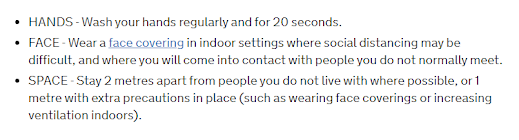
 Anno Domini MMXX The year 2020 has been a year like no other. Thanks to the novel coronavirus and the associated illness Covid-19, the world has been turned upside down. Actions which, only a matter of months ago, would have been seen as ludicrous are now routine. The use of masks, the frequent and almost obsessive application of hand sanitiser, and the treatment of other people like disease-carrying rats would have been unthinkable in 2019.  A tool that governments have employed in response to the spread of the virus is social distancing. Simply put, it is the act of maintaining a safe distance between people to reduce the spread of the virus through aerosols and droplets.   The government's public health campaign of hands, face, space notes (as below), that you should stay 2 metres from people or 1 metre with extra precautions. I appreciate that there's no conversion to feet and inches, creating a simple, clear message.  The NHS website   also do...