Posts

Showing posts with the label signs

The absurdity of the use of kph

Image
  First and foremost I apologise (yet again) for such a long gap in between blog posts. The return of freedom over the past year has kept me away from screens. They say it takes 66 days to develop a new habit. Running is a habit I developed over lockdown, but the return to the office (and I intend to never work from home again) and frequenting the pub has reduced frequency of this.  It is, however, not completely bleak for my physical well-being. Cramming a number of social events in after work has led to me doing a lot more walking around central London. I don’t have an Apple Watch, (other brands of smart watch exist), but my iPhone records my steps and a lot of really interesting data on my walking and running. As would be no surprise, I’ve configured everything in metric units. Thankfully, gone are the days where Apple would dictate to you , based on your location, the units of measurement you use. You have a chose whether to specify distances in miles or kilometres....

Covid-19 has infected the roads, and exposed an inconsistency

Image
Anyone who has driven around any city or town in the UK over the past few months would have noticed huge changes on the roads. Some bus lanes are now operating at all times, cycle lanes have popped up, roads have been closed off, and speed limits have been reduced to 20 miles per hour in many areas. If you live in London, you wouldn't be able to miss extended operating hours of the congestion charging zone. As a driver, these things all irk me, and have been met by considerable objection from a significant proportion of people. The results are not that great either.  Additional traffic jams as a result of either side roads being closed off or lane closures to accommodate poorly thought though cycle lanes on major arterial and/or orbital roads; Drivers getting distracted because they're crawling along a long, non-residential road with few pedestrians or obstacles at 20 miles per hour (32 km/h); Having to suffer the indignity of shelling out £15 in 'congestion charge' for...

How much detail is too much?

Image
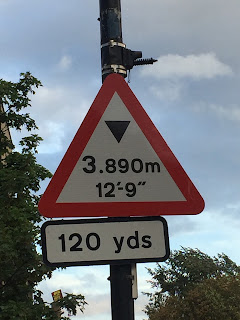
In many facets of life, clarity is key. Relationships, situationships, or anything in-between usually work better when there is clarity. Everyone knows where they stand. What makes these things work better is when the rules only go as far as they need to and no further.  It's much the same with signage. Nobody wants a sign with too much detail. A fundamental rule of clarity is to say what you want to say in as few words as possible. Imagine going to a bar or restaurant and having these two options for signs: Toilets ➝ Toilets straight ahead. Men's toilets at the first door, women's toilets at the second door.  While the second one gives more detail, the first one tells you enough and can be processed more quickly. The first one is all you need and therefore more efficient. The same goes for road signs. Particularly the example below:  First and foremost, I'm glad it's a sign that shows the height restriction in metres, and gives metres priority over feet and inches,...

Misuse of metric symbols: an international problem

Having spent considerable amounts of time in different countries and having visited four continents in the past few months, I've noticed that what many (including myself) consider to be a uniquely British or anglophone problem is in fact prevalent in a number of other countries - some of which have been metric for their entire existence. I've posted images of signs in the UK using 'mtrs' for metres where 'm' should be used and I've discussed the nonsensicality of the use of kph instead of km/h in the British context, whilst lauding the metrication efforts of other anglophone countries in a similar metric limbo to the United Kingdom. Whilst I do stand by my argument that in the UK, we need to fully utilise our official system of measurements, and do so properly, I've come to realise that we're not the only country screwing this up. The most common violation of the BIPM's accepted symbols for metric units is the (mis)use of 'mtr' to re...

Just How Metric is Britain?

With the average person giving their height in feet and inches, weighing their babies in pounds and ounces, quoting distances in miles, it is very easy to forget that the metric system is the official system of measurements throughout the United Kingdom. This begs the question: Why does the imperial system still dominate our speech? To answer the sub question, I will focus primarily on road signs, the vast majority of which are in imperial measures (typically miles and yards). With these being the measurements which most people see on a day to day basis, it impacts the decision people make regarding measurements. Seeing miles and yards on the road is more likely to make an individual speak in miles and yards for distances - in spite of their education in metres and kilometres. This has the knock-on effect of using miles per gallon for fuel consumption (although you would struggle to find an imperial gallon anywhere around) and miles per hour for speed. This has wider impacts in the m...

Metric Signs in Islington

Image
A few years back, I recall there being an uproar spurred on by the BMWA over Islington Council's decision to use exclusively metric units on some road signs. These included height and width restriction signs, as well as speed bump warnings.  The vandals removed and defaced many of the signs and mounted pressure on Islington council to replace them with imperial-only signs.  This has left the borough with a series of width restriction signs that are labelled as  6'6" , when in fact they mean 2.0 metres. (In most other places these are dual-unit signs) Considering that vehicle dimensions are specified in millimetres in manuals, anyone without a calculator is at risk of doing damage to their vehicle.  I managed to find one sign (see below) that escaped the ravages of the BMWA. However, this sign is not without its flaws.  The sign states Humps for 600 mtrs.  According to the BIPM, there should never be any abbreviation for the metre – or any metric unit for th...