Posts

Showing posts with the label metric

The absurdity of the use of kph

Image
  First and foremost I apologise (yet again) for such a long gap in between blog posts. The return of freedom over the past year has kept me away from screens. They say it takes 66 days to develop a new habit. Running is a habit I developed over lockdown, but the return to the office (and I intend to never work from home again) and frequenting the pub has reduced frequency of this.  It is, however, not completely bleak for my physical well-being. Cramming a number of social events in after work has led to me doing a lot more walking around central London. I don’t have an Apple Watch, (other brands of smart watch exist), but my iPhone records my steps and a lot of really interesting data on my walking and running. As would be no surprise, I’ve configured everything in metric units. Thankfully, gone are the days where Apple would dictate to you , based on your location, the units of measurement you use. You have a chose whether to specify distances in miles or kilometres....

Could we try metric time?

Image
The beauty and fundamental benefit of the metric system is its ease of use, which is largely due to it being decimal. Within the system, it is simple to compare the measurements of objects. For example, it takes very little effort to convert or compare a centimetre to a kilometre – much less than comparing an inch to a furlong. For the most part, metric measures are based on an SI base unit, with sub units which are either a multiple or a fraction of ten of that SI unit. A simple example of this is the metre. It is the SI unit for length. A millimetre is 1/1000 of a metre and a kilometre being 1000 metres. However there are some exceptions. With mass, the kilogram is the SI unit, rather than the gram, but still, all measurements of mass are still based on ten around the gram. I am sure none of this is new, but I will get to the point eventually. The SI unit for time is the second. It is common for SI prefixes to be used for times shorter than a second (millisecond, nanosecond, ...

The problem with dual labelling liquids

Image
I was recently looking at double-walled coffee cups - thrilling, I know!  The specific gift request was for "double-walled coffee cups - large". By large, I took it to be at least 500 ml.  Double walled coffee cups are hard to find, but I did find some in the end from Argos. They had a stated volume of 350ml or 12 fluid ounces. Few people in this day and age in Britain know what an imperial fluid ounce is, and rightfully so. With the exception of draught beer and cider, and milk in returnable containers, liquids are sold in metric units and have been more and more since the late 1970s.  It therefore follows that drinking vessels (with some exceptions) should, when sold, mention only metric volumes. So for these coffee cups, there should not need to be any mention of it being 12 fluid ounces.  Whilst dual labelling is a bit cumbersome, it is not the end of the world. After all, priority was given to the metric units and it is probably a helpful step for the older gene...

The complex relationship between aviation and measurement

Image
“It’s a bird. It’s a plane. It’s... more confusion”  The aviation industry is one which holds a special place in my heart, but I won’t bore you with this soppy nonsense. The measurement muddle is truly alive in this industry, so much so, that it makes measurements in Britain seem coherent. Yet still, one of the few global industries manages to work in the midst of a monstrous measurement muddle. Whilst the language of aviation is standardised to English, there is no such standardisation for units of measurement. Metres, geographical miles, nautical miles, inches of mercury, millibars, knots, metres per second are some of the measurements you are likely to come across if you’re ever in the cockpit.  Let’s start with distances. In the UK, as in much of the world, most distances on the ground e.g. runway lengths, are given in metres. Once you airborne, despite flying being a fairly modern feat of engineering, you go back to the dark ages of measurement. Distances now become nauti...

George Orwell and metric units

Image
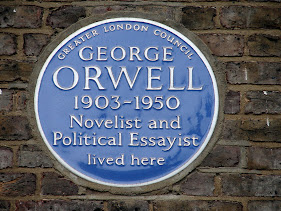
When I first read Animal Farm, I was too young to understand what it was about. I was completely oblivious to the fact that the book (novella, if you must) was an anti-Stalinist satire. I took it at face value, and thought very little about the actual message — though it did leave me with a permanent craving for bacon. The only thing that really landed for me while still in primary school, was the single law which the seven commandments eventually became. "All Animals Are Equal / But Some Are More Equal Than Others." In addition to being totally unaware of the political context of one of Orwell's finest works, I was also completely unmindful of the units of measurement used. In fact, when I re-read it much later on, it was no surprise to me that all units of measurements were imperial. After all, it was published in 1945. Although metric units were first permitted for use in the UK in 1897, they didn't come into common use until around 70 years later. Four years after...

Another symbolic failure

Image
I recently wrote an article about the importance of the correct use of symbols for units of measurements, citing examples of cock-ups from other countries, but had no photographic evidence. Recently, I was in Sri Lanka, where everything (that's not a remnant from its colonial past) is metric - including the speed limits. I was therefore surprised that on the signs speeds were specified in kmph rather than km/h.  (See below). 

The importance of specifying units (and getting them right)

Image
I came across theet of sign, which, although completely metric, bothered me ever so slightly.  Firstly, the use of 'T' rather than 't' for tonnes. Something that needs to be corrected on UK weight limit signs in general.  The lower sign, however, gives a figure of 4425, which we can only reasonable assume to be millimetres. (You can't be sure because the units aren't specified. Maybe it's just a random number?) Such signs give an impression that metric units are complicated when, in fact,  they are much simpler than the alternative.  But the use of the appropriate scale is paramount. 4.4 m would be a much more appropriate for this sign.

Metric Signs in Islington

Image
A few years back, I recall there being an uproar spurred on by the BMWA over Islington Council's decision to use exclusively metric units on some road signs. These included height and width restriction signs, as well as speed bump warnings.  The vandals removed and defaced many of the signs and mounted pressure on Islington council to replace them with imperial-only signs.  This has left the borough with a series of width restriction signs that are labelled as  6'6" , when in fact they mean 2.0 metres. (In most other places these are dual-unit signs) Considering that vehicle dimensions are specified in millimetres in manuals, anyone without a calculator is at risk of doing damage to their vehicle.  I managed to find one sign (see below) that escaped the ravages of the BMWA. However, this sign is not without its flaws.  The sign states Humps for 600 mtrs.  According to the BIPM, there should never be any abbreviation for the metre – or any metric unit for th...

An App-auling Failure

Image
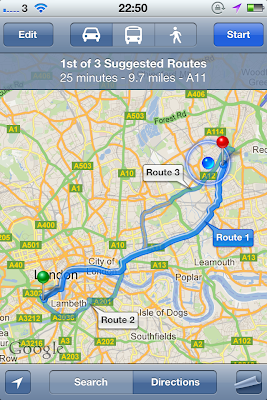
Anyone who has ever had to consult their iPhone for directions would notice one catastrophic failing - their failure to use metric units on their map feature. When I first got my iPhone (almost two years ago now), just like a child with a new toy I was very keen to test out the new features. My first order of business was to find the settings to change the units to metric and lo and behold, there was no option to change it. It seems like Apple use miles exclusively for the Anglophone world, despite the fact that the majority of the English-speaking world officially uses metric units. A bit of research shows that on the original iPhone, the map only featured metric units. These were replaced with exclusively imperial units (probably due to complaints from the overly vocal 'Imperialists') In any case, it is a shame that, at least there is no facility to at least switch units. I suppose only time will tell, but let's keep our fingers crossed that Apple do sort thi...

Graduation Gowns - A Pleasant Surprise

Image
I am just about to graduate from University and am ordering my graduation gown from the prestigious Ede and Ravenscroft. Naturally, when ordering something from a company which has been making ceremonial dress and fine suits for well over 300 years, you just have to bite the bullet and accept that you will have to quite your height, chest size and head circumference in feet and inches. Upon landing on the 'measurements' page, greeted by a drop box which allowed me to change units between metric and imperial. To add to this surprise, the default units were, in fact metric. A small bit of progress it may be, but as they say 'Every little helps'.