Posts

The absurdity of the use of kph

Image
  First and foremost I apologise (yet again) for such a long gap in between blog posts. The return of freedom over the past year has kept me away from screens. They say it takes 66 days to develop a new habit. Running is a habit I developed over lockdown, but the return to the office (and I intend to never work from home again) and frequenting the pub has reduced frequency of this.  It is, however, not completely bleak for my physical well-being. Cramming a number of social events in after work has led to me doing a lot more walking around central London. I don’t have an Apple Watch, (other brands of smart watch exist), but my iPhone records my steps and a lot of really interesting data on my walking and running. As would be no surprise, I’ve configured everything in metric units. Thankfully, gone are the days where Apple would dictate to you , based on your location, the units of measurement you use. You have a chose whether to specify distances in miles or kilometres....

DfT Traffic Signs Manuals Chapter 4 : use of metres and miles per hour

Whilst reading through the Department for Transport's Traffic Signs manual (chapter 4), I came across something rather striking. Striking, as in the fact that stopping distances are in metres, with speeds in miles per hour. Now the reason why this is striking, isn't because I've not seen this before. Everyone who has read the Highway code would already have seen the muddled miles per hour - metres stopping distance many - a - time. However, I came to realise how difficult it must be to calculate stopping distances in miles per hour, since mathematically, deceleration is done in metres per second squared, hence to calculate the stopping distance, miles per hour will have to converted to metres per second. 1 m/s = 2.23693629 mph [compare with 1 m/s =3.6 km/h] I won't bore you with more mathematical calculations, as I've seemed to be doing a lot of recently, but, I'm sure the stopping distances shown in the DfT's manual (and the highway Code) are somewh...

Emissions and metrication... (and apologies)

Image
Dear all, I am sorry I've been inactive with this blog for a while. I am currently studying a few months in Spain, so I've been in the "metric" world. However I went back home last week for a few days, and realised something rather interesting ... ---Start post--- Anyone looking at a car advertisement would be able to notice that emissions are never given in imperial units. It's solely given in gram(me)s per kilometre (g/km). Now we know that this presents a problem, if: a) road signs are in miles b) fuel consumption is in miles per gallon [or even L/100km] Why? for example you're driving in a car with emissions of 100 g/km, for a distance of 385 miles.. how much CO 100g * (385*1.6)km = 61600 g (61.6 kg) . This is still an approximate figure, because I rounded down the conversion factor between miles and km. now if the distance were in km, look at the accuracy and precision. 100 g/km for a distance of 620km (same distance), we get 100 * 620 = 62000 g (62 kg)...

Why I hate multimap...

Image
They show no metric scales... They only show miles/yards and that crap.. see below

The inconsistency of the BBC, but an improvement nontheless!

Image
A few months ago, the BBC would feature wind speeds in miles per hour only... recently, they have included a tap that allows you to toggle between miles per hour and km/h (as well as degrees C and degrees F [absolute rubbish in my opinion]) What was strikng when they first put the tabs up is the way they mentioned km/h as KPH in the tab, annd weather reports and forcasts. As you know, at the moment it's an icebox in London, so I went on the BBC to check the weather... I discovered that now, in weather reports, wind speed is written km/h, rather than the ghastly KPH thing, however the button that one uses to toggle inbetween ... is still the same (see image below). Thank God for small mercies... hopefully in future, they'll do away with mph and Fahrenheit...does anyone actually USE fahrenheit anyway?

Why, Unlike the Rest of the Civilised World, has the United Kingdom not Adopted Metric Road Signs?

Why, Unlike the Rest of the Civilised World, has the United Kingdom not Adopted Metric Road Signs?

km/h speed limits in LONDON!

Image
In my travels around the United Kingdom, I've seen many progressive metric signs, such as metric-only width & height restrictions, metric fingerposts and the like. However, today, whilst walking down "Millionaire's lane" I saw the light... the use of km/h speed limits here in London. One may think of this as being too good to be true if you're a metrichead, and indeed there are some flaws: 1. The km/h speed limit is not a 'regular' number; (24 km/h rather than 25 km/h) 2. The km/h sign is not stand-alone. It is below a sign stating the speed limit in MPH (15 MPH) 3. The km/h speed sign shows uses the horrible kph abbreviation, rather than the the standardised symbol (km/h) With that being said, we have to admit, that this is still good. People are recognising that we can not remain in the dark ages of miles and yards.

Special Report: Antigua

Image
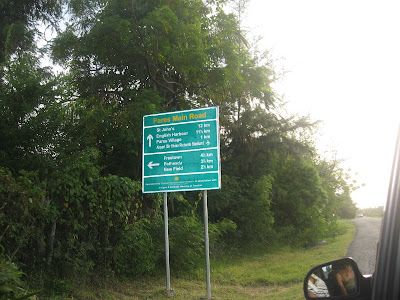
At the moment I'm on holiday in Antigua and due to a heavy American influence here, there is a fierce usage of imperial /US customary measurements. Goods in supermarkets are sold by the pound and ounce, the speed limits are in miles per hour -national speed limit being 40 miles per hour( rounded to 65 km/h) - in spite of the majority of cars featuring km/h only speedometers. However, say the word metre and it's like you're speaking a foreign language. Excluding the use of the litre, the metric system is practically unused  here outside of schools, and it is not understood by the vast majority of the residents. What's interesting however, Antigua has officially gone metric within the last 5 years. The only evidence of this, can be seen in the direction signage, which shows distance in kilometres (and fractions thereof - something which is technically incorrect according to the BIPM's guidelines). I believe they were erected with distances marked in kilometr...